A NEW BOOK NOW OUT. Targets set and achieved.

My third book, 'Targets set and achieved' is now complete and ready for sale. As the title suggests it reflects the past seven years of my fishing. Twenty different rivers where double figure barbel were caught, crucians and roach to near record size, perch, chub, tench and bream to make the mouth water. All will be in the pages and well illustrated with lots of colour photographs.


There is a 1000 copy print run of the hardback edition and a further 40 leather bound copies for the connoisseur.


Copies available from myself just email phlpsmith9@aol.com or ring 07980 394864 for details


Still a limited number of leathers available.


Alternatively use the web page http://www.philsmithangler.co.uk/ where you can order by Paypal or credit/debit card.


Showing posts with label maggot feeders.. Show all posts

Thursday, 22 December 2016

Southern rivers chubbing.

A trip down south can always be that little bit special since both the Hampshire Avon and Dorset Stour hold specimen chub to make the mouth water.  The weather forecast looked good and time was running out for this year so plans were made, tackle and grub laid out and the alarm set for 4.30am ready for the off.

Although busy the roads at this time are not too bad and I get down to Ringwood area just before dawn and I’m soon making my way along the bank to the swim I had chosen for today.   A deep water run with a long line of bushes and trees along the opposite bank to give perfect cover for the chub that would be my target today.   I’m down for two days and have brought six pints of red maggots; I can always get more from the local tackle shops in Ringwood if needed.  My first task is to bait drop six droppers of maggots across to the head of the swim, that done I can take my time in tackling up the rod and preparing for the day.   My tackle is the same as I’ve used for several years while after chub.  A 12ft Drennan IM8 Feeder Rod is paired up with a Mitchell 300 reel loaded with 6lb line.   I will use a running Blackcap feeder setup and the 3” hook link is 4lb Fireline going to a size 18 Drennan Superspade hook.

Casting across the fast flow under my own bank gives two potential problems, the first is the amount of debris coming down the flow in the form of dying rush and streamer weed.  This at least ensures that a regular recasting takes place which can be all to the good especially when the minnows are about.   At the moment it seems that the grayling have also had a successful time and these can be a problem as well.  The second problem with that fast water is that of netting the fish once hooked.  This trip, as with so many others in the past the hook holds were right on the outside edge of the lips where the fish were very cautious, but could not resist the maggots.  Constant casting and the occasion top up with the feeder kept a stream of maggots going down under the bushes and I hoped that the chub would eventually respond.  They did and my first fish was almost at my target 7lb weight but fell short at a very pleasing 6lb-10oz, my largest for a couple of seasons.  The Avon is a magical river being crystal clear most of the time but seeing a monster fish fighting on that light tackle can give heart stopping moments.

                                                           Avon chub of 6lb-10oz.

That was my only action off the chub and I was sure that there must be others in the swim, to that end I changed my plans and determined to return next day to take advantage of the feed already placed in the swim.   One of the question marks you always have when you go fishing is that of whether somebody fished the previous day and hammered the fish?  I at least knew the answer and with just the one fish caught I also knew it was worth a return.

The morning was wet with drizzle coming down for most of the time.  With maggot fishing it just means you need to take extra care to keep them dry, the slightest sign of damp and they can crawl even upside down and around the lid.  With the same tactics as the previous day I soon had a few taps that indicated that the fish were there though nervous.  It took time but eventually one made the mistake of just taking the maggot too close and he was lightly pricked though enough for me to land him.   This fish of about 4lb was soon followed by one 4lb-10oz but then the next one slipped the hook which was almost expected so not too disappointing.


It went quiet after that but then I hooked an obvious big fish, it might have been a barbel but the fight suggested a large chub since it tried to get to the branches.  I thought I was going to land him and was well down from my starting point having followed him a little way downstream.  He held in the middle of the river though too deep to see and then he made a dive for the far side trees again.  I allowed a little way but then stopped him and my hook link broke.   Pete suggested it could have been a seatrout with their serrated jaw, it makes sense but I’m still wondering.

Monday, 6 April 2015

The large bream campaign begins.

The river close season used to mean the end of fishing for three months, now I can continue to enjoy my sport but only on allowable still waters.  I have been trying to catch a large perch of one such venue and although I caught to well over the 3lb mark as mentioned in the last blog I still await the 4lb fish I hope is swimming around there.

                                                           A 3lb perch that still holds spawn.

As we move into April my thoughts change to the tench and bream potential and with very little change in the rigs I cast further out and hope for a large bream to show.  The main problem with bream is their nomadic nature on most venues, you may see them rolling but that only tells you where there are at that moment not where they will be or where they will feed.
Over the many years that I’ve fished for the bream I imagine I’ve tried every known method and bait in their pursuit, the only conclusion I’ve come to is when they are prepared to feed they can be easy and caught on almost any method.  The other side of that coin is that most of the time they are very difficult, if not next door to impossible.
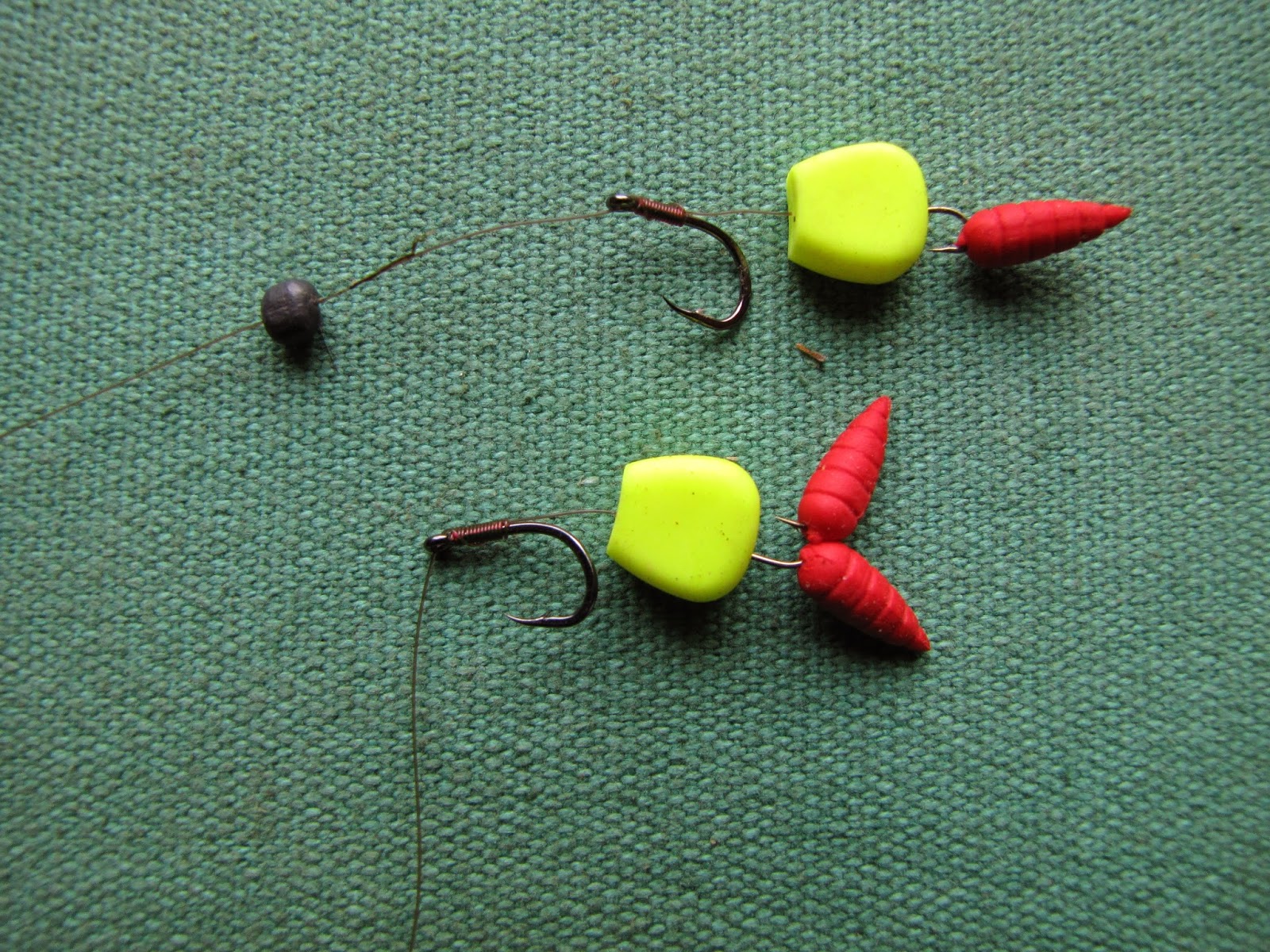
This early in the season I had decided on a very frugal approach and just rely on maggot loaded swimfeeders and a double hook rig with the maggots on the hook nearest the feeder, then an artificial corn/maggot combination on the top hook.  This is not going to going to make a big catch of fish but so far this year just three bream have been caught, all singly with this suggesting they were not shoaled up.

                                              Pull the small hook into the corn and job done.

With the overnight rain I expected the water temperature to have dropped and with the east wind blowing it was not with the highest of expectations that I set out for an afternoon –evening session.  Rods are already set up and it was just a cast of casting for the horizon and sit back and wait.  I recast every hour but it was more a case of hoping a fish would come across the feeder offering and pick up the hookbait.  In the words of the famous saying ‘nothing kept happening all the time,’ but that had been the case on my previous visits for the bream so no surprise there.

It was well into the afternoon when one of the bobbins dropped slightly and then gave a little giggle.  It was not the usual bream bite that hits the deck in one movement and I was quite surprised to hit into heavy resistance on the strike.  Playing the fish to the bank I discussed the possible culprit with the lad who had come along from the next swim.  Not a perch, no bangs typical of their fight, possibly a tench or maybe a jack pike since they have been picking up maggot baits, not a bream though since it was too good a fight.  Fifteen yards out it flashed on the surface and to our surprise it was the bream I had hoped for, when the scales showed it weighed in at 13lb-8oz it was a very nice welcome to a new water venture for the bream.  The fish had taken the artificial bait proving yet again their worth in the angler's armory. 

                                                                   First of the year.


Saturday, 28 February 2015

A review of February - Part 1.

Arriving back from Suriname during the third week of January was a definite wake up call, I say ‘wake up’ but in fact it put my fishing on a definite sleep mode waiting for the temperatures to rise up again to something like normal.  Many years ago I would go fishing irrelevant of weather, but now I’ve gone soft and like it to at least be above freezing when I’m on the bank in daytime.

                                                From a time when I did go in freezing conditions.

After about three weeks of this layoff I decided I must go fishing and so I arranged with a friend to spend three days on the Hampshire Avon after the monster chub that live there.  It was still quite cold especially in the northerly winds, but enough is enough and I wrapped up well and arrived at Ringwood about midday on the 10thFeb.  I already had a thought as to where I would start providing the swim was free and as I drove down the nearby track I looked across the field to see it was indeed available, first part of the plan in place.  For me, winter fishing for chub is fine tackle, small hooks and either maggot or casters.  Cheese, meat and pellets and other baits will obviously work as well, but I love the feel of a very large chub on tackle that he could break with a flick of his tail, now that is exciting.  My tackle this time is a Drennan Medium Feeder rod and the usual Mitchell 300 reel loaded with 6lb main line.  The large maggot feeder is used with Drennan ready tied size 18 or 20 Superspade hooks to take either a single or double maggot.

                                              A smaller feeder than used but still a chub setup.

My swim is typical of the Avon in winter in that it is racing through on a very fast glide but my saving grace is that of slower water alongside the rushes on the far bank, with 30gram of extra lead on the 50gram feeder and the rod held high to keep most of the line out of the faster water I can just hold.  In these conditions the extra weight does not deter the chub too much, finely balanced against the flow the slightest pull on the bait will dislodge it and the tip is seen to quiver as the fish moves downstream with it.   With small hooks there is no need to strike, just pick up and play the fish, no problem in that, except the fish is on the other side of the raging river and I have got to bring it across on the tiny hook.

                                                  Opening swim on the Avon

I bait dropped both hemp and maggot at regular intervals and around 5pm I finally got my reward as the tip quivered and I began the heart stopping fight against a fish that initially was determined to run into the rushes by his side.  Fortunately I could pull him away or at least hold him in place, if I had been on that bank I would undoubtedly lost him since there would be little chance of stopping him moving the few feet to his side.   Holding him making the rushes was the first part of the battle and now as he moved away from them he was in the extra flow to help his already powerful runs.  This is where the Mitchell comes into its own for me.  I have used them for near 50 years and in this situation they become part of my arm, I don’t need to think when playing a fish on fine tackle and I rely on a backwinding method as I feel necessary.  With most reels if you set the clutch to cope with the sudden lunges on 2.5lb line you cannot reel against a powerful run, hence the backwinding method.  It has been over a year since I had seen a very large chub and as this swam past under the bank in crystal clear water I thought I had a 7lb specimen on the hook, when I finally landed him the scales showed my error in that it weighed 6lb-6oz, still very pleasing for the first day.

                                                              6lb-6oz Avon Chub

The following day produced just one bite again and this time it weighed in at exactly 6lb so good average but a definite lack of bites.  With a total blank on the last day it confirmed the local opinion that the fishing was hard at the moment, still with two 6lb plus fish not too disappointing!

                                                 The second 6lb of the trip.

My first river trip for barbel was in fact on the 17th February and I went to the local Warwickshire Avon with the thought that just possibly a stray barbel might feed.  It had been very cold for some considerable weeks and now there was a definite increase in temperatures going 6C or even 7C during the day so worth a chance trip.  An extra bonus was the heavy rain a couple of days earlier and the river had rising noticeably, I’m a firm believer the floodwater can beat the cold when looking at whether barbel will feed or not so here goes.

I had gone onto a section of river that I had not previously fish and my first choice of swim looked perfect, a large obstruction mid river gave a big slack below it and fast flow down either side, surely a barbel must live here.  Several casts and one 2lb chub later I had found the problem, with the river well up it was not so noticeable but I’m sure a visit in the summer will show either heavy rush beds or cabbage beds all along the nearside bank and out into the slack area.  Each cast had been snagged on roots and a couple of times I thought I would need to pull for a break before it finally came clear at the last moment, time for a move.

The next swim was a narrow neck where the river came off a good size pool, strong flow along the far bank and a far steadier pace from the nearside bank out to just over half way across.  There was not a crease as such but the difference in the flow rate was noticeable and I felt hopeful that a fish would lie in the water just off that fast pace to conserve energy, worth a try anyway!
Tackle was as usual 1.75lb test Drennan Barbel Specialist with Shimano 5000RE reels loaded with 12lb line, a large swimfeeder to take my pellet mix and hemp goes down to a 12inch length of 15lb Pro Gold mono to act as a stiff rig and this is tipped with 6inch of 15lb brain with a size 8 Drennan Continental Carp hook tied with a knotless knot leaving a 0.5inch hair rig in place.  Two or three 10mm Elips pellets are then superglued onto the hair and all is ready.


                                                  My first barbel of 2015.

Fortune favoured my efforts and it was not too long before I was looking at my first barbel of 2015, a fish of about 7lb that did not fight all that well in the cold water, perhaps he had only just woke up from his enforce nap.  My next trip on a river the following week proved far more productive, but I will write that up tomorrow.

Monday, 9 September 2013

Further bait and wait tactics explained.

I was both surprised and pleased to see the very high number of people that looked in on my last blog and since this suggests a good interest in how to use the bait and wait idea I thought I would expand the topic a little further.  That first blog covers the barest details of the method and anyone approaching this idea thinking it is just a matter of buying bait and you’ll catch loads of barbel is in for a disappointment.  As with most angling technics it takes time and practice to get the best out of the method but once mastered it can be and is a deadly tool for catching a lot of fish.
That last bit mentioned is an important part of the equation, lots of fish.  This is not the method to try for just one fish unless that fish is a particular specimen that you are trying to catch.  Then this can be the tactic to fool that ultra-wary big specimen that refuses to look at all normal pellet/boilie/meat offerings.

                                                 A 15lb-3oz that fell to the method.

Under the best of conditions it can be useful if the initial practice to get familiar with the method can be done on waters where the fish can be seen.   This would give the angler the chance to observe the results of his efforts and then transfer them to the more normal situation where the water is too deep or coloured to be able to see in.

                                                        The artificial caster rig

                                                  Bait for a maggot attack

So what do you need to start with and I would suggest that in an ideal world you begin in a swim you already know or suspect there are a reasonable number of barbel present most of the time.  Now you decide on whether you will use maggot or caster, both can work well though the caster have the advantage of being heavier and hence hold in the swim more easily.  Whichever bait you chose they will be introduced into the swim along with the hemp via the use of a bait dropper.  There are many models on the market and currently I prefer the Dinsmore copy of the older Thamesly version.  These are a small plastic dropper that does not have the weight of the metal modals and hence I find I can cast and control them better.  I do wrap a length of extra lead around the stem in order that they drop through the water more consistently, lighter models can be affected by the flow.  Here it is worth noting the length of the stem is also important, too long and the body of the dropper is too high above the bed of the river and when the particles are released they can be washed well downstream rather than into your swim.  This is especially true for maggots as they are by far the lighter of the two baits.  You have cast the dropper out, it went straight down and opened; now you hold the rod low and just flick the tip in order to encourage the bait still left in the body to come out.  If you lift the rod straight away the particle left in the body will rise into the flow and be washed downstream.  It might be that with perhaps one drop in ten you lift on purpose in order to send some of the feed downstream to leave an extra food trail, this will be added to the scent trail of the hemp that is the main attractor to bring the barbel from downstream.

                                                     Bait for the caster attack.

Now to look at how much bait to use and here is the most difficult aspect of the method to identify.  I could say “how long is a piece of string,” but that would be no good to the reader trying to come to grips with the method so I’ll try to be more expansive.  As always cost must be an important part of the equation, general hemp is not too expensive especially if brought in the 15K sack and cooked yourself.   Expect to pay about £1.5 dry weight and this will near double in weight when it swells and takes on water when cooked.  The maggots and casters are very varied depending on your location but generally casters will be £3 plus per pint.
My normal comment on this point is that the most valuable thing you use on a day’s fishing is your time.  Once that day has gone you cannot get it back, you can replace money so in that sense it is less important.  Of course you need the money in the first place, but surely it is better to do one day fishing with good tactics, than to spend the time and fuel costs going three times with inferior tactics.
So how much bait?  I would suggest that a good day with a reasonable catch rate could be gained with 4 pint of caster or maggots.  I would take extra hemp since it is less expensive and can be frozen if left over.  This is another factor in the caster/maggot choice,  casters need to be used with say one week of purchase if they are looked after, maggots will last for weeks if kept in a bait fridge set about 2C.   That said you can try less caster well mixed into the hemp, say twice the hemp to caster rather than equal parts.  At a push this could be taken to three times hemp to caster but eventually the results will definitely suffer.
Now you have arrived at the swim with enough bait for a full days sport.  No rush to tackle up since this method is the most social system it is possible to try.  Put the bait dropper rod together first and drop out say ten drops of hemp and ten of caster [assuming your using the Dinsmore model].  Now you can go for a walk, read a book, have a chat with your mate a little way back from the river, it does not matter.  There is no set time table for the pattern that follows, experience, practice, gut feeling all play a part and this is where the top lads in the method show their skill.  Many anglers over the years have said that this is just buying you fish, get a gallon of caster and you will bag up, but nothing is further from the truth.  A gallon or even two or three gallon of caster in inexperienced hands will not have fish jumping onto the hook and all they will be doing is feeding the fish.
You need somewhere to start so try and use say 45 minutes as a guide interval between the initial baiting.  Following that first drop you wait the 45 minutes then drop again but this time slightly less, say four droppers of each then wait again.  Following that you can either do a further bait drop and wait, or you can bait drop and follow up with a first cast in straight away.  Either way when you do cast in then be prepared for an early take, often the fish are now well on the feed and even though a dropper has landed between them they will perhaps move away but they quickly return.  If it does not happen like that don’t worry just follow the pattern and watch for the slight movements on your rod tip that would suggest the fish are in the area and feeding.  As a guide if you see this tip movement and you wait a long time before you get the take then maybe you have put too much feed into the swim so when you next bait drop use just two droppers instead.  Whatever the case you do a bait drop after each fish and at least consider resting the swim after three fish are landed.  Complete the drop as normal following the capture but then just leave the swim for thirty minutes or so to give the fish the confidence to return without disturbance.  The days are long and you will definitely reap the rewards of this rest period rather than just catch, catch and so on.

                                                                             The caster rig.

Last, let us look at the tackle, mainly right at the hook end since behind that does not matter too much just as long as it is strong enough.  Much has been written about the hook length to be used for barbel and other than the fact that generally the short hook links used for chub and roach don’t seem to work I would be fairly open minded as to what you would favour.  I use between 12” and 18” and for maggot /caster work I would use a strong size 10 hook, currently I use the Pallatrax pattern but there are many others that will do the job.  I prefer to use about 10” to 12” of 15lb heavy mono to act as a stiff rig and to this I attach my 15lb braid with a loop to loop fixing.  For the loops I use a figure of eight knot and this has not let me down.  The bait is put on a hair and generally I would attach four casters in a torpedo style figure.  This will prove proof against most attacks from the small fish since it just moves out of their way when they try to grab it, should they still prove a problem then just slide one artificial along the hair and superglue two or three naturals to that.  Now if the small fish attack you always have a hook bait that the barbel will pick up.  If possible I will still use casters on the hook even when maggot fishing, the maggots are just too difficult to stop the small fish attacking them and leaving just skins when you reel in.  As a rule once I cast out I will use a straight lead with casters and leave it for 30 minutes or more whilst with maggot fishing I would use a swimfeeder and recast more often say every 5 minutes to start with and going to 10 or 15 minutes intervals later in the session.
There you have it then, catch fish you can use lots of bait, less fish will use less bait, no guarantees but when you get it right the sky is the limit and you can empty a swim of barbel.  Practice makes perfect and trial and effort will give a timetable to suit your situation.

Tight lines until the next blog.

Friday, 24 May 2013

Crucian tactics and success.

With May approaching fast my thoughts return to these beauties and I hope I can get some of this sport again.  This is last years blog of a successful session.


With this weather pattern that seems to be stuck in the late winter mode the fish would seem to be at least a couple of weeks behind in their development towards spawning, this can be an advantage as long as they will feed and that seems to be the rub.  My local tench water is fishing very patchy, but most of the time poorly, that is the report I get from all over the country, odd good catches and fish, but lots of blanks or low numbers of fish caught.  With this in mind I decided to concentrate on the crucians at Marsh Farm and leave the tench until a later date when they still might have the spawning to complete.
                                                              Home for a few days

                                                                   Baiting up as always

I’ve already given a report of my first trip and since then I’ve returned twice with varied results.  The weekly papers gave a very good report of a couple of great catches made in the recent weeks since the lake opened again on May 1, but don’t be fooled into thinking it’s easy, they were exceptional results.  The fish seem to be in small groups, get a swim with one of these groups in front of you and you can catch half a dozen crucian, but next door on either side of your position could be a total blank.  The tench are prolific and by and large the crucian anglers don’t count them at all since the size range tends to be quite small at between 1lb and 4lb most of the time.  The occasional nicely coloured rudd puts in an appearance and these can run up to around the 2lb mark to make an interesting diversion.
                                                                    Colourful rudd

My return for a second session resulted in just two crucians with another one lost and I was beginning to wonder what I needed to do in order to get a reasonable result, but as with most times when you are not catching it was just a case of getting onto the fish.  These sessions tend to be about of 50hrs duration over three days and for my next try I arrived about 10:30am on the Tuesday and began a walk around to see what was happening so I could choose a swim for the next couple of days.

                                                          Ready for the crucians

One big advantage of staying on the same venue and within a narrow band of end rig change is that the same tackle will be used making starting up again simple.   The rods are still made up and everything is ready to go.  Mix up my feed to go into the swim and a method mix for the feeder, only slightly different since I want one to break up while the other needs to bind on the method feeder.
                                                        One of the hookbait versions.

I, along with many other writers have written thousands of words on rigs for the different species we fish for, that said the one I’m using now will catch nearly species very efficiently and without any complicated tackle needed to construct it.  When looked at the flatbed method feeder is only a slight variation on the helicopter rig used with a swimfeeder, both use a short hook link to place a hook bait next to the feed that goes out into the swim.  If I only had one method I could use this would be it.

As before, the tackle is Drennan 1.25lb test 12ft Avon rods with Shimano 5000RE baitrunner reels loaded with 6lb line.  30grm method feeders and size 14 Kamasan B980 hooks are used with 4 inches of 4lb Fireline braid to make up a killing combination.  My method mix is based on Dynamite Green Lipped Mussel method mix with a few extra bits added and the hookbait will vary from sweetcorn,  6mm soft pellet to artificial casters.

I had arrived to find most swims taken with just one left so it removed the need to choose, sometimes a good thing as I am a firm believer in fate and she certainly looked after me this trip.  The story on the bank was bad, several anglers after the crucians but only two fish caught over the previous thirty hours or more.  Even the tench that are normally such a nuisance were slow with just a few wetting the occasional net.  I was all set for yet another low score with a blank the most likely result.  With the marker float out to give a reference point the Spomb along with the other two fishing rods were marked up for distance using a suitable elasticated thread,  then the feed went out, a mix of groundbait, mixed pellets and corn and I’m ready for fishing.

I cast the two baits out and continued to set up my camp, I always have the rods out first unless it’s raining, I was still doing this when the bobbin rose and I struck into my first fish of the session, a terrific start even if it’s a tench but as it came to the net I could see the flash of gold – it was a crucian.  Not only a crucian but at 3lb-12oz it was my best from this venue beating a 3lb-10oz fish taken on Harris Lake over behind my current position.  Following that my sport continued fairly evenly through to dusk with fish of 3lb-8oz, 3lb-5oz being the better crucians and a number tench to a pleasing 6lb-3oz.  I brought the baits into the edge at either side of my swim once darkness approached, just off the bushes since although the depth is only a couple of feet they do move in to feed on occasions, but not this night and dawn broke without any interruption to my sleep.
                                                 Very pleased with this 3lb-12oz crucian

                                                                          3lb-8oz gem

The following day started well with a couple of early tench but then nothing until 2:30pm when a moderate crucian, at least for this venue, of 2lb-8oz came to my waiting net, sport was on again and it continued through the afternoon into the early evening.  Mostly it was those smaller tench between 2lb and perhaps going up to 5lb but there were enough crucians to keep me on my toes.  I kept a little feed going into the swim using the smaller of the two Spomb to just top up the swim follow ever second fish, it seems reasonable to assume that there are more fish out there than you catch and it needs a little feed around to keep them interested in coming back to the swim.  I say coming back since it does seem they go off on a route march and eventually return when you again catch a few fish before they move away again.  In-between the feeding spells the swim can seem quite dead until they return.
                                                         Yet another 3lb plus specimen.
My total of crucians slowly built up which seemed quite strange since most of the other anglers were struggling for a bite, I’ve been there over the last two trips so they had my sympathy, perhaps their turn next time.  That second night the close in rods did produce with a big 2lb crucian followed at about 11:00pm by a fish that left no doubt that it was not a crucian.  As I played this fish on tackle not intended for the job a friend came up to ask if I fancied a cup of tea, I declined the tea offer but encouraged him to help with netting the fish.  My net was one of the smaller pan nets not intended for this size of fish and when it finally came to the side after much argument it smashed the fork without mercy leaving us to net it by the lad holding the remains of the frame and guiding the fish into the net very carefully.  The carp weighed in at a very pleasing 23lb-6oz and the net was easily repaired with a normal metal spreader block after the remains of the original plastic spreader had been removed.
                                                The net was not up to the carp's size.

                                                                 23lb-6oz hard scrapping bonus.
                                    3:00am and with the setting moon all is well with my world.
The following morning went much the same and by the time I left to beat the M25 traffic I had raised the crucian total to twelve of which seven were over the magical 3lb bench mark.  My trip back home was through some quite nasty weather and it was the prelude for what was to come, I definitely chose the right days to fish but that is part of the equation of success.
                                                                   A very successful session.

Sunday, 10 June 2012

A tench fishing bonanza part 2.


Following the result of the previous day as described in part 1 of this piece I got to the lake a lot earlier.  Although Rob had already got to the venue 15 minutes before I arrived he had kindly left the swim vacant even though he knew of my results, just for this one day mind you, tomorrow is open house on swims again.

The results of yesterday had suggested that the maggots out fished the corn about 2 to 1 so I had decided to fish both rods on the maggot feeders.  Again no extra feed would be used since this idea obviously worked the previous session, although I did not expect to repeat that result I was hopeful that just maybe I would get the big fish that I had possibly missed.
                                                           Drennan in line swimfeeders.

Today started more sedately in that it was probably a couple of hours before the first fish put in an appearance, I was not sure if that was just they were nervous with the number caught the previous day or the fact I had started a lot earlier.   In the event that first fish made it all academical since it was a new personal best for the water and when Rob confirmed 8lb-15oz it came as a double edged sword.  Nobody in their right mind can think that one ounce is a get deal, but this one ounce short of my target 9lb weight did make a difference far greater than its size.  That small individual quirk aside I was well made up with such a magnificent looking fish and thought that irrelevant of the results for the rest of the day it would have been worth the effort.
                                                      8lb-15oz pb tench for this water.

Of course I did continue to fish in the hope of even larger specimens that were potentially in front of me but it was not to be.  The sport was slow but steady as fish after fish came to the net, several more 6lb tench were landed and then yet again I hooked a big fish that immediately put the thought of yet another carp in my mind.  It would just not respond to the pressure I used on the 1.75lb test rods and that can be quite considerable.  Of course there would be only two possible options, it either came in or I would pull the hook, lady luck was watching and I did finally get it to come to my net, all 8lb-6oz of it.  Slightly smaller the previous big fish but a far better fight and yet again I fished on with a big smile on my face, definitely building up to be a couple of days to remember.
                                                                 8lb-6oz of powerhouse.

Towards the evening I landed a 7lb-11oz tench that really made the day as one of a nine fish haul, no carp this time but I am not fishing for them so that was no loss, with a total of 25 tench over the two days with three 8lb plus fish and a further three 7lb plus amongst them I retired well satisfied and looking forward to the next session after the big red eyed monsters.
                                                       At 7lb-11oz hardy a small tench.

Thursday, 7 June 2012

A great time with big tench, bream and carp.


I am sure that like me you often leave home and you are going tench fishing,  or maybe perch fishing, perhaps a day after roach or bream, but how often do those plans go astray and you are lead up the garden path by other species than your target fish of the day?

Tuesday and Wednesday of this week were such days for me, I went tench fishing and did indeed catch some very nice specimens but it did not end there.  On the Tuesday it all seemed to be in my favour, got there about 6:00am and dropped into a swim with the wind blowing into my bank.  I had already decided to fish two totally different methods on the two rods I would be using.  The first rod would have a double hook rig with the maggot feeder on it and the usual short hook-link size 12 Pallatrax hook to carry an artificial maggot along with two or three natural maggots as well.  The second hook would have a couple of Dynamite shellfish 8mm boilies attached since I’ve had occasions where the tench have gone really well on that bait.   The second rod would be set up with a flatbed method feeder and the bait would be a single artificial grain of red sweetcorn.   Using these method feeders it is simple to embed the corn into the method ball by placing a layer of the method into the mould and pressing the feeder into it to get a nice compacted bundle.  Now you lay another shallow layer of feed in the mould again and placing the hook bait on top of this layer you compress the feeder into this and you have a slightly larger compact parcel that includes the bait inside it.  A big advantage of this is that it casts like a bullet and cannot tangle; it will also sit on the top of a weed bed to present the bait cleanly to your target fish.
                                                        Method ball with bait inside.

I was soon into the first fish of the day and this proved to be a small male, it is quite annoying to keep getting these little blighters where a 5lb fish is a good size and fights well, but those females are so much bigger.  That came on the method but when I hooked the next fish on the feeder rod I initially thought ‘this is the one.’  Then it kept on going, slipping the clutch like a wild banshee on a rampage and I soon realised I had hooked one of the lakes big carp.  The fish did put up quite a good show and with lots of water to go at it made good use of it, fortunately normal tench tackle is still quite sturdy and as long as I did not run out of line I could eventually land even the biggest of the lakes residence carp though at 21lb-4oz this was well short of that fish.  My silver bream fishing early this year had produced a 20lb plus carp, and now my tench fishing had done the same, best of it is I don’t carp fish, it is the only one out of all our coarse fish that I no longer pursue, even my pb English carp of 37lb came on tench gear with two maggot on a size 14 hook.
                                                                 21lb-4oz common as a bonus.

The carp had taken the white boilies and although I did take a further three tench on the maggot hook with the maggot feeder rod, it was the other set up that saw most of the remaining action.  I had noticed that this rod was casting its bait into an eel grass weed bed and I took care to keep within that area.  Tench after tench came to the bank, a 6lb-15oz fish was beaten by one of 7lb-8oz and then a 7lb-2oz went into the middle of these with the total tench for the day finishing at 8 fish.  That was quite a good day’s result, but it did not end there and in between the tench I took two sizable bream with the best one tipping the scales to 6lb-13oz, not my usual stamp of bream but pleasing never the less.   So with tench, bream and carp all hitting my net whilst on my ‘tench fishing session I realised that no matter what we might think we are fishing for anything can and usually will happen!
                                                                   6lb-15oz specimen.

                                                               7lb-2oz beauty.

                                                             7lb-8oz best of eight tench.

Day two saw me back at the lake to try again for the bigger tench that so far have eluded my efforts.  This time I went with the method feeder on both rods using the red corn as bait since this had proven to be so successful the previous day.  It was the same wind but noticeably warmer, the previous day having been decidedly chilly.  With heavy showers forecast I had put the shelter up and this proved a wise move but the fish seemed to take pleasure at giving a take right at the moment of the heaviest downpour.  Today followed the results of the previous day with both tench and bream coming to the net.  The tench topped out just short of the 7lb mark but the bream went bigger with two samples of 8lb-8oz and 8lb-11oz.   Pleasing fish since the water has not been known to produce double figure bream as of yet and these were spawned out fish capable of hitting that figure with the extra weight the spawn would give, maybe next year will see them do it.
                                                         8lb-8oz spawned out bream.

                                                         My best bream from this venue at 8lb-11oz.

I ended the day with four fish of each species and I left with that bigger tench still on my mind as I thought in those famous words ‘I will be back.’